By Emmanuel Adeshugba, Tech Team, Intern, Aspectus Group
The term CEO is likely the most corporate sounding title there is in the workplace. What typically springs to mind is an older man in an expensive suit and tie at the head of a boardrooms.
However, this mental image is slowly becoming a thing of the past. In the technology space the image of a suit and tie is slowly being replaced by a 30-something-year-old in much more casual attire with an office in the heart of Shoreditch.
The slow phasing out of the old corporate images of the past can be seen as a movement into a new era where the focus is less on professional protocol, but instead on results and revenue – whether that is done in dress shoes or flip flops.
This move does come with some externalities that are becoming a staple in the tech industry. The CEOs of large tech companies such as Mark Zuckerberg, Jeff Bezos and Elon Musk are transcending the corporate boss character and are becoming celebrities themselves. With Jeff Bezos having over three million followers on Instagram and Elon Musk with his notorious and sporadic Twitter account.
From a technology PR perspective, does this help or hinder the company’s reputation?
Elon Musk’s tweets are controversial mainly due to their ability to move the markets. The tweets by Musk have had a heavy effect on his own company’s price sinking his stock by 12% after tweeting a poll about selling 10% of his stake in the company. It’s not just his company that he’s impacting though, one tweet by Musk in 2020 caused the price of bitcoin to skyrocket by over 10% in a single day.
The benefits of CEO PR
In a more transparent commercial world public relations extends past just the company and applies to the personnel that represents said company. Unfortunately, the cliche of “all views are my own” does not apply when given the title of CEO in a firm resulting in a need to present a more positive stable public image.
Having the power to control markets in the hand of one CEO with an iPhone can be a scary thought for anyone and is likely a PR teams’ nightmare, but there can be benefits to this.
The personality of CEOs can become a brand in and of itself that individuals, who may not have heard of the brand before, will now know through the CEO.
Ultimately, this new wave of CEOs with big personalities could be seen as a move in the right direction for firms in a generation that requires more transparency, authenticity, and engagement before making decisions on where to spend their money.
We’ve also seen how media fails can turn into media wins with the likes of BBC dad – when Professor Robert E Kelly let his corporate mask slip and showed viewers some personality – which showed us showing your human and softer side doesn’t make you make. It just makes you relatable.
We’ve worked with some of the most exciting chief execs across the globe to make them household names. To find out more about media training and how we do this for you or your business, get in touch: tech@aspectusgroup.com.
Awards are a great way to get your company, employees, colleagues or even yourself noticed as frontrunners and innovators in the tech industry. With several new technology awards emerging year on year, it can be hard to manage these and know which ones are best to go for.
Here are some of our top picks for technology awards in 2022 to enter:
UK Business Tech Awards
The UK Business Tech Awards looks for innovative and exceptional applications of technology that can be used to transform and grow businesses.
The awards include a variety of categories such as Healthtech Pioneer of the Year, Fintech Innovator of the Year, Ecommerce Company of the Year, Edtech Company of the Year, and SaaS company of the Year, among others.
Entry deadline: 1 July (17 June for Early Bird)
Shortlist announcement: 29 July
Awards Ceremony: 13 October
Women in Tech Excellence Awards
In an industry that is still largely dominated by men, the Women in Tech Excellence Awards aims to reward and celebrate women in the tech industry.
The Women in Tech Excellence Awards were designed to help the technology industry move towards a solution by recognising and promoting women.
There are 18 categories in which candidates can be nominated for, these include CIO of the Year, Entrepreneur of the Year, IT Leader of the Year, Security Leader of the Year and Software Engineer of the Year, among others.
Entry deadline: 29 April
Finalist announcement: August (exact date TBC)
Awards ceremony: November (exact date TBC)
The Cloud Awards
The Cloud Awards celebrate the best in Cloud Computing and is the first and largest awards platform of its kind. It is partnered with The SaaS Awards.
The awards aim to attract nominees across the globe with a focus on striving to not be solely US-centric.
Entry deadline: end of October
Awards ceremony: TBC
The SaaS Awards
The Software as a Service (SaaS) Awards, is partnered with The Cloud Awards. The SaaS Awards looks to represent software across the world and equal weighting is given to all countries and individual awards in any category may be split into more than one award if the strength of submissions is impressive across regions.
Entry deadline: end of May
Awards ceremony: TBC
CRN Channel Awards
The channel is a large part of the tech industry, and the CRN Channel Awards look to celebrate the power of the channel.
Described as one of the most prestigious technology awards in the UK IT channel and with a rigorous judging process, winning a CRN Channel Award is a great achievement that any company within the channel should aim for.
Entry deadline: 1 July (entries open end of April)
Awards ceremony: 10 November
CRN Women & Diversity in Channel Awards
CRN is also hosting their 5thWomen & Diversity in Channel Awards. The aim of the awards is not only to celebrate women and champion wider diversity within the industry but also recognising that the challenge of increasing diversity across the country (and the world) is far from solved.
Entry deadline: 9 May
Awards Ceremony: 13 October
Banking Tech Awards
FinTech Future’s Banking Tech Awards have returned in 2022 for their 23rd year. Nominations are open to financial institutions, banks as well as technology services and software providers. There are 32 categories, including a category for best COVID-19 response.
Entry deadline: 22 July
Awards ceremony: 1 December
The Tech Trailblazers Awards
The Tech Trailblazers Awards looks for tech companies across a variety of sectors such as the Cloud, Developers, FinTech, Mobile, Security, Blockchain, AI and Big Data. As an award for “Trailblazers”, categories are open to private companies either privately funded or VC backed (Series C or earlier) and under seven years old.
This is a great technology award to enter for newer companies, especially those with unique and innovative solutions to technology problems.
Entry deadline: 31 August (Early bird deadline is 4 August)
Shortlist announced: 14 October
Voting closes: 4 November
Awards ceremony: 15 November
The Heath Tech Awards
Following the pandemic, health tech seems to be more important than ever, and the industry has seen an insurgence of great innovation and talent. The Health Tech Awards has categories which range from patient care and services to mental health solutions to video consultation software.
Entry deadline: 23 June
Finalists announced: 13 September
Awards ceremony (digital): 13 October
At Aspectus, we’ve won multiple technology awards for clients. From handling the research through to drafting compelling and creative entries. Get in touch if you’d like to win more awards in 2022: tech@aspectusgroup.com.
With Europe’s biggest investment management equity trading conference, TradeTech, returning to its physical form in Paris this Spring, here are Aspectus Capital Markets’ top tips to ensure a successful communications strategy at the event:
Expressing key messages – It’s what this event is all about! Have your key messages clear in your mind, whether that is for panel sessions, or just chit chat at the cocktail mixer in the evening. You need to be able to position your company as having something to offer in the space, and strong communication is the key to painting a clear picture of what solutions you offer.
Quiet space – This is especially important for any media interviews that you might have set up ahead of the event. We have found in previous years that it can be almost impossible to have a decent interview at the stand or amongst the hubbub of the conference. Scoping out a quiet spot off the beaten track to conduct your media interviews can be vital to ensuring these chats convert to great media coverage!
Understand your audience – Tailor your messaging to whoever you think is most likely to be crossing your path at the event. Analysing the list of those attending ahead of time is vital to get the most out of any conference as it will enable you to plan what you want to get out of it.
Initiate conversations – In a room of so many voices, simply being present can be too passive. Getting about and initiating conversations with people at the event is crucial, and if possible, have meetings set up ahead of the event, with both prospects and the media. Social media campaigns around the event can engage key targets before you’ve even entered the room.
Thought leadership – This conference presents a unique opportunity to elevate yourself and your company as thought leaders in the space, be that through partaking in engaging panel sessions, having valuable conversations with peers, or securing great media coverage through insightful interviews with the journalists who will be in attendance.
Integration – Having a unified approach across marketing, sales, and design to maximise your success at conferences is the most effective way to shine, from creating an eye-catching stand as a vendor, to spreading awareness of your participation in the event through engaging social posts throughout.
Enjoying yourself – We are all excited to be back at in-person events after several years of drab digital conferences. Once all the panel sessions are complete, it’ll be a welcome change to enjoy yourself with a cocktail or two at the mixer afterwards – I know that’s where we’ll be!
Stick to the script – You have to clearly set out your key messages and weave them throughout your entire communications strategy at the event. Tying this into the topic of the conference – Equities – is vital, as this acrostic blog shows!
Amelia Fillis and Brad Starr from the Aspectus Capital Markets practice will be in attendance at TradeTech Equities in Paris – if you would like a conversation about how we can help with your comms strategy or just want to pick our brains, please get in touch on
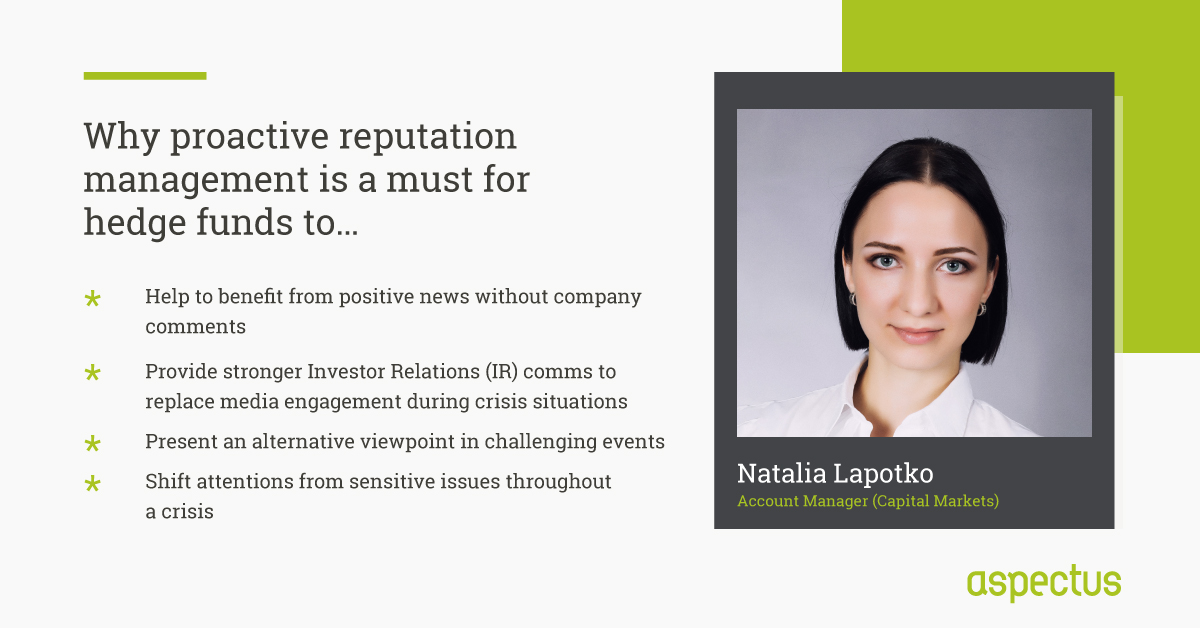
By Natalia Lapotko, Account Manager, Aspectus Capital Markets
Economic uncertainty following tragic events in Ukraine puts a spotlight on hedge funds, institutions that are specialising in hedging risks and controlling the intensity of their exposure in financial markets. A crisis like this is a test for major players and a potential death sentence for smaller ones. For the second time since 2020 global markets are undergoing massive changes and like during the COVID crisis, hedge funds find it increasingly difficult to stay “under the radar” as journalists are assessing how various players are facing this challenging time.
According to this FT article market turmoil is splitting hedge funds into macro winners and tech losers. Macro hedge funds enjoy one of their best Q1 results, while technology and growth funds experience double digit losses. Funds with a heavy focus on Russian assets attract a lot of attention from media and vocal supporters of tough sanctions on Russia.
From a communications perspective, this is a good case study showcasing why it is important to secure proactive reputation management ahead of turbulent times.
Helping to benefit from positive news without company comments
In March, BH-DG Systematic Trading fund and Systematica Investments secured positive coverage thanks to their strong performance. FT, for example, explained this success by the fact that these are computer-driven and macro quant funds trading without human sensitivities. These hedge funds educated the audience about their strategies and their benefits in the past and consequently experts used them as examples of a successful quant approach. It is interesting to note that Systematica Investment’s image is powered by its CEO Leda Braga whose nickname is “the queen of quants”. This illustrates that a hedge fund can benefit from the strong public image of its leadership.
Providing stronger Investor Relations (IR) comms to replace media engagement during crisis situations
In April Tiger Global’s 34% slump was widely covered in the media and although the hedge fund declined to comment on this matter, media outlets quoted the firm’s investment team letter to investors:
“In this moment, we are humbled, but steady in our conviction and confident about the go-forward opportunity.”
Although this note hardly changes the situation, it still shows the hedge fund’s willingness to honestly communicate with its investors.
Like many other hedge funds which lost in this situation Melvin Capital, which ended first quarter with 20.6% loss, declined to comment and Bloomberg’s piece on this matter appears to be less favourable without any mentions of IR communications.
Presenting an alternative viewpoint in challenging events
FT story on Firebird Management which pioneered investments in the Soviet Union and is still heavily focused on Russia illustrates that engagement with media can help to present an alternative viewpoint even in situations which appear to be inherently negative.
The article cites Harvey Sawikin, Firebird’s co-founder and lead manager of its eastern Europe and Russian funds, admitting that this risk could have been addressed. While declining to comment on potential losses, he stressed that many investors are interested in buying cheap Russian assets as they are expecting bargains on them. This approach allowed the hedge fund to present itself as a transparent institution which can admit its mistakes but also provides an alternative viewpoint on a very challenging situation.
Shifting attentions from sensitive issues throughout a crisis
During a crisis, like never before, it is useful to have several ongoing projects presenting the company as a forward-looking organisation. During turbulent times, when actual performance may be suffering, this may help to shift the attention from negative agenda. For example, in April HFObserver published the results of its study showing that hedge fund firms hired women for almost half of new ESG jobs. Although media outlets that picked up this news did not cite specific companies, it was a good opportunity for hedge funds to feature on the ESG front.
Conclusion
As the 2020s uncover one crisis after another, hedge funds must be ahead of the curve in their communication strategies. A proactive communication strategy powered by strong IR capabilities can help hedge funds to smoothen negative coverage and own a story when a player benefits from dramatic events.
Undoubtedly the future will bring more crisis situations and it is never too late to start preparing for them. Prep work can not only help to handle a crisis but even to benefit from it.
By Catherine Hunter, Senior Account Manager, Aspectus Group
Boris Johnson’s energy strategy has been on the cards for a couple of weeks now. As with many crises, the time to plan was yesterday and action is needed today.
The squeeze on energy bills was being discussed before events unfolded in Ukraine and now this concern has been converted into a full-blown crisis. This week alone has seen France recording its second highest ever short-term energy prices. A global issue, that’s seen the UK Government consider how to reduce reliance on imported fossil fuels providing security and decarbonisation.
Most in government plan policies to have an impact during the current five-year election cycle. But energy has always felt a bit different; decarbonisation and energy security are big issues to tackle. Building a big nuclear power plant (or eight as suggested in the strategy), or tidal lagoon project has felt like the legacy impact some ministers were looking for. The Capacity Market was partly introduced to provide a financial route to market for more large-scale gas power plants. For years, governments have grappled with the energy trilemma of how to keep the lights on with cheap, green energy.
And yet, here we are. Talking about yet another crisis.
Short term thinking
We are a week into the new price cap level and time is short to protect the public from October’s further rise. And so, we need to be considering short term options that can have an impact today. Building eight new nuclear plant takes years so, while a great option for future energy security, it still leaves many people feeling insecure today.
One of the biggest areas of consumption for households in heating (63% in Britain). This spring the boiler upgrade scheme (BUS) comes into force. It will provide upfront capital grants to support the installation of heat pumps, and in some circumstances biomass boilers, in homes and some non-domestic buildings. The BUS will be open to properties located in England and Wales.
Planned out in October of last year, it feels like a big step forward in removing inefficient boilers ahead of next winter. But an efficient boiler – or even heat pumps which are now cheaper to run than gas boilers – aren’t sufficient to keep the current cost of living crisis at bay.
Energy efficiency
Homes in Britain are amongst the “leakiest” in Western Europe. And sadly, this is a story that’s over a decade old. We’ve had the chance to improve our homes, to protect from rising costs and reduce reliance on fossil fuels and haven’t.
And that leads us to wonder why.
Cost is obviously a barrier, no renter will install double glazing as they won’t see the bill’s impact, and no landlord will install it as the property is still habitable without. And for those that own their home, if they have spare cash in the bank, a shiny, new kitchen will always win that debate.
However, installing efficiency upgrades can shave hundreds off our bill every year so green backed loans are one solution to take the heat out of the initial decision, which the government could – and arguable should – have focused on today.
The government isn’t wrong to look at onshore and offshore wind as a long-term solution, but the strategy doesn’t provide the security needed to improve bills today. And what’s better, once insulation is improved it keeps the heat in tomorrow too – providing a long-term energy reduction strategy.
No one is going to suggest energy efficiency has the same cool credentials of purchasing a trendy, new electric vehicle to help with decarbonisation but some clever sustainable energy comms could go a long way to insulate consumers from the worst of the bills crisis.
Maddy Stichbury, Account Executive Financial Services
It’s been a whirlwind. Becoming an account executive with no prior media experience has meant learning on the job – and quickly! So here are the five most important things to learn about the media before coming in cold turkey.
Roxhill is just the beginning
Roxhill aka the Bible of PRs. Sure, it can give you the email and often phone number of any journalist you are trying to track down, but media relations extend way past this database. Just last week I attended my first ever ‘journo coffee’, an interesting encounter that felt like a mix between a Hinge date and a job interview.
However, it has directly resulted in three pieces of top tier coverage and a podcast appearance. Once you actually meet a journalist, they are much more likely to open your email when they see your name in their inbox. Building personal relationships with journalists can be key to securing coverage – especially in those top tiers.
Another thing to keep in mind is that Roxhill is unfortunately not the most exhaustive list of publications – especially when your clients operate in more nuanced sectors. For example, there are many popular crypto blogs that do not find their way onto Roxhill – despite often being leading publications in their field. Google is your friend when expanding a press list and Roxhill has run out of options.
Sing to the journalist’s beat
If you haven’t had at least one short tempered journalist sighing down the phone, you don’t work in PR. However, commonly it’s because you’ve phoned the UK editor asking if they’re interested in a fintech story in Africa.
Working in fintech PR there are multiple journalists with vague job titles, so it’s important to do research; check journalists’ recent stories, get journalists on the phone to ask them on what they are currently writing and make sure to update press lists anytime a journalist changes their beat.
Then personalise pitches to each journalist to increase engagement. It might seem time consuming but knowing exactly what journalists’ want to write on is a top tip to securing coverage.
Knowing your sector will help you to secure coverage
One of the reasons that clients hire us is because we are subject matter experts. This means that you can never know too much or stop learning. Yesterday it was embedded finance, today it is the metaverse, tomorrow is who-knows-what.
Understanding the subject matter is necessary to be able to identify relevant breaking news stories and drive coverage results effectively and independently.
Newsjacking, letters to editors and reactive commentary are all good tactics to secure coverage, especially in top tiers, but it needs to be done within 24 hours of the story being published. None of that can happen unless you really do have your finger on the pulse.
Plan, prepare and then be flexible when it all goes wrong
Writing yourself a to-do list every day and carving out time to focus on various tasks is the best way to stay on top of your workload. Planning your time to the (almost) hour may help you stay afloat. However, flexibility is equally as important. In my short life as a PR, I have pitched two releases under embargo that were delayed multiple times. This is a sure-fire way to ruin your meticulously planned week, not to mention ensuring your email is added to the spam folder by journalists.
Therefore, flexibility is essential. As is having no shame when you need to call the journalist for a fourth time that day to update on yet another embargo change.
Subject lines are the key to unlocking journalist’s attention
Sparking enough interest to open an email in a limited number of characters? Easy! I, an avid tweeter, first believed – how wrong I was. Subject lines are an art form and testing the waters with multiple variations and tracking which have the most success is key.
Media is always evolving and it’s important to never stop learning. I’m excited for the lessons my next three months will teach me.
International Women’s Day (IWD) has been celebrated around the globe this week, commemorating women worldwide and all they have achieved.
This year the theme of IWD is #BreakTheBias – encouraging us all to break free from stereotypes and discrimination to create a free and fair world for all.
We sat down with five of our Aspectees, to find out what IWD means to them and how the communications ad branding industry can help women achieve their goals.
What does International Women’s Day mean to you?
“For me, it’s about ensuring that people are treated with the same respect or afforded the same opportunities regardless of their gender. IWD is a way of us showing girls and women all over the world that they have as much meaning as anyone else on this planet!” – Jamee, Account Director
“For me, it’s an opportunity to not only celebrate what it means to be a woman, but benchmark progress too. I love all that it means to be a woman, and seeing others smash through the glass ceiling is a valuable reminder that the possibilities are endless.” – Ruby, Account Executive
“IWD is a celebration of the social and economic progress women have achieved through resiliency and a reminder there is more work to be done.” – Ivy, Senior Account Executive
“It’s a way for us to celebrate progress in gender equality today, as well as remember those who paved the way by challenging social, political and cultural constructs throughout history.” – Astrid, Deputy Head of Energy and Industrials Practice
“To me, IWD is about bringing equality to society more generally. Yes, we want to celebrate all the amazing women across the world and the monumental achievements they make, but our end goal is to form a completely level playing field.” – Tamsin, Senior People and Experience Manager
Even though the workplace is becoming more equal, there is still much to be done. What’s the biggest challenge you’ve faced in the workplace as a woman, and how did you overcome it?
“A big challenge I have encountered is feeling unheard by older males. To overcome this, it’s important to remember you’re in the same room because you’re qualified and deserve to be there. Confidence is key.” – Ivy
“I agree. It’s important to believe in yourself and what you’re saying.” – Tamsin
“I’m not an engineer or a technical expert. I’m also usually one of maybe a few women in the room. Working in the energy industry can be tricky because people don’t know why they should trust you. You don’t need to be an expert in everything – it’s a good thing to never assume you’re the smartest in the room – but knowing enough and combining it with the things you’re an expert in will gain others respect… and they’ll listen to you.” – Jamee
“There have been situations in my career when I don’t feel I’ve been taken as seriously because I am a young woman. My goal is to say thank you for the challenge – now let’s show you what empowered young women can do!” – Astrid
“My biggest challenge is imposter syndrome. Even in a room full of other women, it can be difficult to believe that my ideas are valuable to others. Learning to trust my inner voice and have conviction is something that I’m still working on, but I can already see how far I’ve come working at Aspectus. I put it down to the flat structure and working in such a supportive and collaborative team.” – Ruby
What do you think the communictions and branding industry can do to help women more in the workplace?
“We’re lucky that in PR there are a lot of very incredible and talented women. I’d love to see more of them specialising in the energy sector, but both industries need to open those doors for women in this space.” – Jamee
“Our industry is female-dominated, so it would be great to see more females in senior positions.” – Tamsin
“Yes. Change occurs from the top down, so seeing women in leadership positions not only in our industry but across all sectors is extremely valuable.” – Ivy
“Talk about it. Gender inequality still exists – consciously or unconsciously – in many different forms for men and women. There needs to be an acknowledgement and a commitment to change. Thankfully I am surrounded by people that support this. Not everyone is – so as an industry, we need to ensure this stays top of the agenda.” – Astrid
“It’s crucial that the industry takes intersectionality seriously. We must consider everything and anything that can marginalise people to truly make progress.” – Ruby
What advice would you give a woman starting their career in the marketing industry?
“You will face challenges others won’t. And others will face challenges you will not. Commit to creating a positive difference while forging your path, surround yourself with people of the same mindset, and never be afraid to speak up.” – Astrid
“Go for it! You are more than capable.” – Ruby
“Your path might not look like the person next to you, but it doesn’t mean it’s any less.” – Tamsin
“As a woman, we often feel this pressure to act like the men in the room – don’t. Be completely yourself. We all have incredible attributes, and you don’t need to ‘be the man’ to get what you want out of your career or life.” – Jamee
“You may have a different experience than your male counterparts, but always be confident and resilient. Undoubtedly life will throw you curveballs.” – Ivy
And finally – who is your most inspiring woman, and why?
“My most inspiring woman is my Grandma. She single-handedly raised my Dad after her Husband passed away, then she helped raise my brothers and I when my Mum wasn’t around for a lot of our childhood. She’s 82, still works, and just really cares about other people. She inspires me every day. My work ethic, my morals – they all come from her.” – Jamee
“Definitely Malala Yousafzai” – Ivy
“My Mum. She taught me the value of hard work, how to be firm but kind and understanding – she was my teacher for some time, so I saw her a lot in a professional environment. Most importantly, she made me feel like I could conquer the world.” – Astrid
“Greta Thunburg as her defiance unsettles people (in the right way). She manages to shake up the patriarchy by refusing to play up to it, and standing strong in what she believes in.– Tamsin
What we’re doing to #BreakTheBias at Aspectus
Our industry has a long way to go to help women grow and succeed in their roles. While most of those in the industry are women, men dominate over 60% of agency boards.
Nearly three out of four of our Aspectees are women, and we work hard to help them thrive in an agency environment.
We’ve built an environment that ensures women not only reach the glass ceiling, but smash it wide open. From our highly regarded and successful buddy system, where women in the industry can support and mentor other women starting out in the industry to achieve their goals, through to a flexible working environment, paid time off for studing, career development, and an excellent maternity package – our fantastic benefits ensure that women are supported in achieving and being all that they can in every aspect of their lives.
Find out more about how we’re helping women in communicatiins and branding achieve their goals, not only on IWD but all year round.
We understand that interviews can be daunting, especially if it’s your first one, but we’re here to put you at ease.
If you’re applying to The Aspectus Academy, our London apprenticeship (or any Aspectus role for that matter), interviews are simply an opportunity for you to tell us about how great you are, and a way for us to get to know each other.
Here are our top five tips to calm interview nerves, help you feel prepared and, ultimately, ace your interview.
1) Research the job role
An important part of interview preparation is researching the job or apprenticeship you’ve applied for. Think about:
What you’re excited about and why – consider if there’s a particular sector or element you’re looking forward to most.
What your day-to-day responsibilities will be – if applying for a PR and marketing apprenticeship, you’re likely to be talking to journalists, brainstorming creative ideas, writing social media posts and supporting the team. If it’s an accounting job, it will be maths based, spreadsheets and thinking analytically.
What makes a good candidate – think how you can perform the job well. From practical skills like writing or organisation, to personality traits. At The Aspectus Academy, we’re after drive, positive thinking, creativity and teamwork.
Our second interview tip is also about research. This time, about the company.
A good place to start is the company’s website. You’ll usually find pages like ‘Culture’, ‘About’ and ‘Blogs’ which will introduce you to some people who work there and give you a feel for what the vibe is like.
Company websites are also the best place to find out what a business actually does. For example, Aspectus is a global integrated communications agency – meaning we do PR, digital marketing, social media, messaging, strategy and more! We also work with different clients, different sectors and have clients across the globe. Check out our ‘Services’ and sector pages online to find out more.
You don’t need to know absolutely everything, so don’t waste time learning obscure facts. But do make sure you understand what a company does, and why you want to work there.
3) Prepare answers to common questions
This is where your research comes in handy. Interviews are a free-flowing conversation, but you can generally bet on being asked certain questions, so prepare answers ahead of time. For example:
Tell us a bit about yourself
Why would you like to apply for this job or apprenticeship?
What skills do you have that will help you in the role?
What’s your proudest moment?
What are you most looking forward to and why?
If you’re applying for our London apprenticeship, The Aspectus Academy, make sure you’re confident chatting around the questions on the application form.
4) Prepare questions
At the end of your session, interviewers will often ask if you have any questions for them. Asking questions proves that you’re passionate and genuinely interested in the job or apprenticeship.
You also need to know if this is the right fit for you, so use questions to learn more about the role, the company and the industry. Interview questions to ask include:
What’s your favourite part of your job?
How did you get into this industry?
How can I prepare for the role ahead of time?
What is the company culture like?
Think about what you want to know, then go for it! There’s no such thing as a silly question.
5) Prepare for the interview environment
In a world changed by Covid, it is important to consider the setting of your interview. If it’s online, make sure you can access the application (Zoom, Microsoft Teams, Google Meet etc.) and you have the link to hand. Sometimes you must download an app onto your laptop, so make sure this is done before the day. You should also test your webcam, speakers and mic.
For the interview itself, try to find a quiet environment with stable Wi-Fi. This could be somewhere at home, or if you’re applying for The Aspectus Academy apprenticeship, you could do it at school.
If your interview is in person, you’ll need to figure out how to get there. Make sure to plan your journey in advance, especially if taking public transport as you never know what can happen!
Despite all this, sometimes things go wrong; if you’re ever unsure or struggling to get online/somewhere for your interview, let the interviewer know. For The Aspectus Academy, email academyjobs@aspectusgroup.com.
Back yourself!
With all this considered, the final thing to remember is to be yourself. Employers like to get to know your personality and they appreciate authenticity.
Interviews can be scary but thinking about it in a different way will calm your nerves – this is an opportunity to shout about yourself and reflect on all the amazing things you’ve done! By following these tips you’ll feel better prepared, now you just have to trust the process. You’ve got this.
By Tarik Salih, Financial Services Senior Account Executive, Aspectus Group
If the last few seasons of Premier League football has taught us anything, it’s that PR is alive and, quite literally, kicking.
Football is becoming far less about results than it is about how these results are perceived by the game’s key stakeholders – namely, the media and fans. In many respects, it’s a subjective sport but the onset of social media in the last decade has magnified the role of perception.
Take the toughest job in football, management, as an example. Almost a decade ago, Sam Allardyce, one of the Premier League’s longest serving managers observed: “I won’t ever be going to a top-four club because I’m not called Allardici, just Allardyce”, suggesting that foreign managers are favoured over English managers. And he has a point. Despite achieving multiple promotions with mediocre squads, pioneering Bolton into a top eight side for four consecutive seasons, and never suffering relegation, he has never managed a top side – something which arguably many other less qualified Premier League managers have achieved.
Even if manager PR isn’t a tangible thing, there is no doubt it affects coaches’ job prospects. In other words, like many English managers, Allardyce has a PR problem.
This is largely a symptom of owners becoming astutely aware of the role that perception and PR play in the modern game. So much so that, in recent years, it is guiding many on-and-off the field decisions, whether rightly or wrongly. Appeasing fans through an offensive, sexy style of play, a big name signing, and a witty social media team are (in many cases) trumping the importance of a long-term, considered, and purely football-focused strategies.
Top-flight football has highlighted another thing: PR needs to be done right. In a Times article, pundit and ex-footballer Gary Neville, recognises that PR and social media are a big part of the game but argues that it is often at the expense of authentic emotion, a fundamental pillar upholding the sport: “some of these tweets and posts are diversion tactics. You feel manipulated reading them and this is meant to be football, not… [an attempt to control] the narrative.”
But controlling the narrative doesn’t have to be a way of manipulating or deceiving fans. It should rather be a way of effectively communicating the club’s vision, avoiding confusion and the inevitable frustration. That’s effectively what PR is in the modern age: that everything you do, and everything you say, must hang together as a coherent whole so that key messages and values are consistently communicated over time.
If done correctly, both footballers and managers can become effective communicators who can connect with millions of fans through their social channels. The growing presence of even the most old-school pioneers on social media, including Jose Mourinho and Pep Guardiola, highlights their recognition that PR is an important factor in the modern game.
The need for effective communications and PR in football is at an all-time high. Overall, it reveals that PR remains a powerful tool which exists in many walks of life, even if its presence is not immediately obvious.