Our latest ESG report examines the current communications landscape and the extent to which ESG factors are considered a strategic priority – both for communications and wider business plans.
In March 2024, we surveyed senior marketing decision makers working within the financial services, energy and technology sectors across the US, UK, Middle East and APAC.
The report examines the practical – and strategic – considerations for effectively communicating ESG efforts, alongside the more conceptual challenges with the specific ESG term and its direction for the future.
Download our whitepaper and gain insights into:
How far ESG considerations have been embedded into communications and wider business strategies
Whether the term “ESG” is fit for purpose
How pervasive the risk of inadvertent greenwashing activity is
Hear from the most influential Marcoms leaders in Asia!
Watch our webinar and delve into key findings from our latest ‘Marcoms in Asia’ whitepaper alongside LinkedIn, TerraPay & IPRS, moderated expertly by Rachel Kelly, Radio presenter at MoneyFM.
Hear insights on how to build brand loyalty in a culturally diverse continent, what it means to be ‘digital first,’ the impact of Gen Z on the new workforce and their predictions for 2025 and what trends marketers should be watching out for.
Our expert panellists include:
Joyce England, Senior Communications Director
Juveria Samrin, VP Marketing at TerraPay
Su-Ren Neo, Head of Marketing at LinkedIn
Koh Juat Muay, President of the Institute of Public Relations of Singapore
We hope you enjoy. Please get in touch if you’d like to hear more about our services in Asia.
Aspectus invites you to join our webinar delving into key findings from our latest ‘Marcom in Asia’ whitepaper, alongside some of the most influential leaders in Marcoms in this region.
What you’ll learn
Here’s a glimpse of what we’ll be covering
Building brand loyalty in a culturally diverse continent How can you navigate nuances and seize opportunities?
Digital first strategies Is the industry integrated enough or are we operating in siloes?
Gen Z and the new workforce How do we leverage the talents of this dynamic cohort?
Industry outlook in 2025 & beyond What trends are emerging that have the potential to reshape the future marketing & communications landscape in Asia?
Register now
Registrations are now closed for this event.
Meet the speakers
Rachel Kelly
Senior Presenter at MoneyFM
Webinar Host
Joyce England
Senior Communications Director
Panellist
Juveria Samrin
VP Marketing at TerraPay
Panellist
Su-Ren Neo
Head of Marketing at LinkedIn
Panellist
Koh Juat Muay
President of the Institute of Public Relations of Singapore
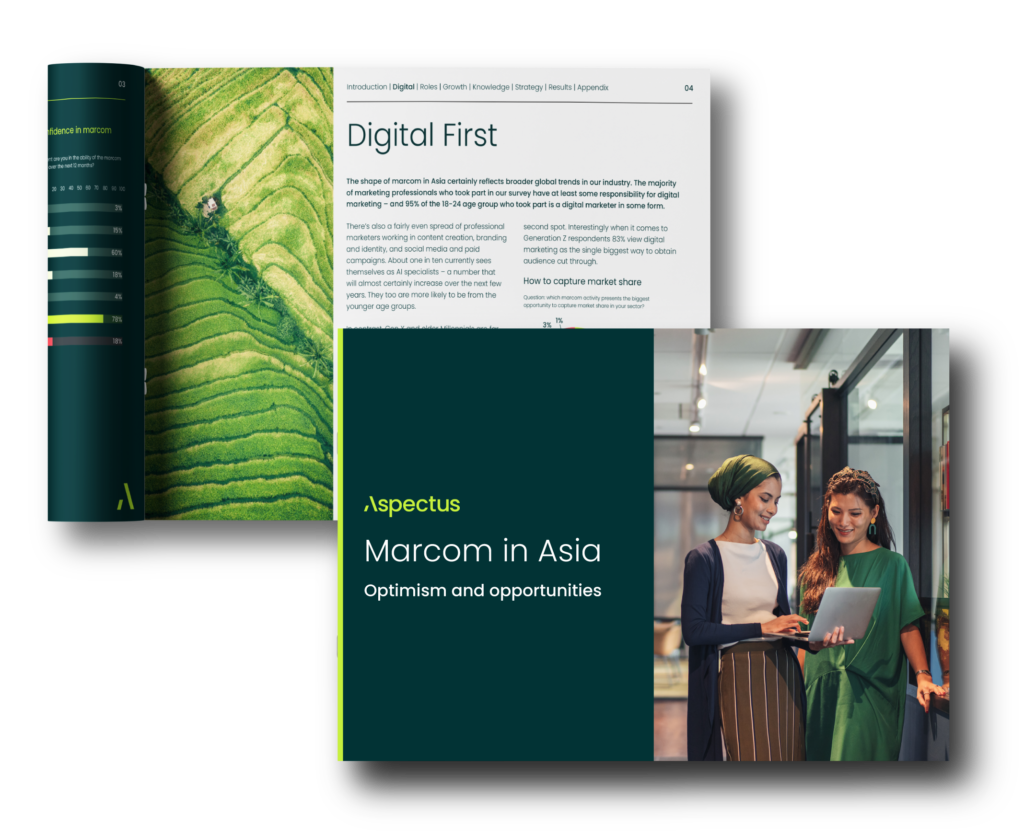
Optimism, increasingly integrated, a sector ‘on the up’ and confident of aiding business growth. Those are just some of the clear messages from the Asia-based PR, marketing, communications, and branding professionals who took part in our recent YouGov powered survey: Marketing Communications in Asia: Optimism and Opportunities.
Across generations and in businesses of many sizes a significant majority (78%) are positive about their own ability to capture and grow opportunities for their business or their clients. Furthermore, nearly half (48%) of respondents feel this is a sector on the up, building on successes and looking for new opportunities.
While optimism is the common denominator, there are anxieties – be that understanding and making full use of all modern marcom channels, or properly combining traditional practices such as PR with newer, digital ones. A shortage of skill sets too, in areas such as UX/UI or SEO and SEM is an issue that must be addressed.
All of this aligns with what we are hearing from our growing client base in the region, as we continue to expand our on-the-ground presence in Singapore.
Asia is a dynamic and often complex marketplace, with brands competing to establish their identities all while jostling to engage with diverse audiences and adapting to evolving demands in consumer behaviours.
We are delighted to be able to bring this detailed piece of analysis marcom professionals across the region. As well as detailed quantitative results that have been written to inform strategy, partnerships and provide detail on how to drive business goals we have also gathered the thoughts of some of the leading marketing minds in Asia.
Koh Juat May President, Institute of Public Relations of Singapore believes this report will bring the value and awareness marketing communications to the forefront of what is a fast-evolving technological revolution.
There is within, further commentary – for which we are incredibly grateful – from:
Gwenne Chen, Head of Marketing Communications at AsiaNext
Christopher See, Head of Marketing, SGX FX
Lucas How, Marketing & Communications Manager, APAC Services, Sulzer Singapore
Louise Veitch, Head of South East Asia, Aspectus
We do believe you will take a lot from this document, be that evidence or insight into making strategic decisions on which marketing channels to harness for upcoming campaigns, enlightening data around current and future marketing trends, or information that had not crossed your radar regarding skill shortages or agency partnerships.
Discover:
The key to building trust and enhanced brand loyalty in culturally diverse markets
Which communications channels are taking centre-stage in marcom strategies?
Why tangible marketing results are pivotal to unlocking budget
The skillsets the marcoms industry needs for the next era of marketing communications
“Marcom specialists in Asia increasingly recognise the need to deliver sales-boosting results. Omnichannel campaigns can demonstrate achievements, often overlooked. Earned media and PR, known for enhancing brand awareness and sales, are hard to quantify. Integrating these into digital marketing campaigns provides concrete evidence of success.”
Koh Juat Muay President, Institute of Public Relations of Singapore (IPRS)
Have a listen to our panel of experts discussing the challenges of ESG communications in South East Asia. They share lessons learned in regards to branding, marketing and communications decisions surrounding ESG and debate the importance of stringent reporting to hold businesses accountable.
The brilliant Lynda Hong, Senior Environment Correspondent at The Straits Times moderated the discussion with our panel of experts being:
Kavita Gandhi, Executive Director of the Sustainable Energy Association of Singapore (SEAS)
Ken Hickson, Founder and Chairman at Sustain Ability Showcase Asia (SASA)
Joyce England, Head of Corporate Communications EMEA and APAC at Experian
While the benefit of incorporating environmental, social, and governance (ESG) factors into business strategies is widely understood, there is still a fear among many of getting it wrong. Do too little, and you risk accusations of not caring; but do too much, and you risk being accused of greenwashing.
With both possibilities having real business consequences, navigating this road is challenging, but crucial.
The key lies in communication. Ensuring that the way you are conveying your ESG strategy is careful, precise and considerate, of both your audience and your context.
Download our whitepaper to delve into the ins and outs of ESG communications from our team of experts, where you’ll gain insights into:
The importance of having an effective ESG communications strategy
Dodging the landmines and avoiding getting it wrong
Making sense of the maze of terms, and how to use them effectively
As the home of some of technology’s greatest advancements and inventions that changed the world, Silicon Valley has become synonymous with innovation. And, whilst numerous cities have tried to replicate both its technological advancements and name, from the Silicon Valley of India (Bangalore), to Silicon Alley (a term coined in the 1990s during the dot-com boom in New York City) and Silicon Valley North (used to describe Ottawa during the 1990s), the term hasn’t quite stuck. Recently, however, Singapore has gained the coveted status of ‘The Silicon Valley of Asia’.
With Southeast Asia’s tech start-ups predicted to be valued at $1 trillion by 2025, Singapore is key to the region’s success. The country’s successful financial sector, government support and compelling policies which attract tech companies, and advanced infrastructure ensures its triumph as the next global technology capital. However, Singapore, much like San Francisco did, seems to be carving its own path within the technology world.
This blog will explore how Singapore is on its way to becoming a global technology hub and giving Silicon Valley a run for its money.
Singapore’s secret to tech success
Singapore’s rapid development in the late 20th century transformed it into a major manufacturing and financial hub. But the continued drive to invent and innovate – which are ingrained in Singapore’s culture – have helped to foster a collaborative environment for both startups and established companies within the technology industry.
Additionally, thanks to its advanced IT infrastructure and intellectual property laws, Singapore offers tech companies an attractive base for development products and solutions. With an increasing number of tech companies, Singapore’s government is promoting tech courses to help close the skills gap and continue the country’s trajectory as the technology capital of Asia.
As a small nation, with a population of just over 5 million, Singapore knows it needs to attract tech talent from across the world as well as upskilling its own citizens. The country’s Tech.Pass is targeted towards tech entrepreneurs and leaders allowing them to come to Singapore to work on trailblazing technology further encouraging the growth of its technology sector.
What’s next for technology in Singapore?
With an extraordinary story of growth, innovation and resilience, it is clear that Singapore has its sights set on becoming a Smart Nation.
As Singapore encourages citizens as well as businesses to implement technology to make lives easier, from investing in robots to help plug the foreign worker gap during the pandemic to finding ways to integrate virtual and augmented reality into everyday life, it is inevitable that the country’s digital transformation will see large continued growth.
As it works towards ensuring a fully digital society, economy and government, the prospect of attracting tech talent will only grow as workers and companies look for seamlessly advanced ecosystems to help their business goals and growth. With a booming technology sector, Singapore is leading the way towards becoming a Smart Nation and, undeniably, has the potential to become the true technology hub of Southeast Asia and perhaps even globally.
If you are keen to branch out and build your technology presence in Singapore, then talk to us at Aspectus where we can expertly guide you through your tech communications from our Singapore PR agency to help quickly boost your next stage of growth. Get in touch here.
By Paul Noonan, Lead Copywriter, Energy and Industrials
Clean hydrogen has long been hailed as the green lifeblood of the future economy, helping store and circulate renewable energy across sectors and decarbonise hard-to-abate industries and heavy transport. It is at the heart of the energy transition, holding the promise of decarbonising sectors that cannot be easily electrified and even providing the Holy Grail of dispatchable renewable power in the form of hydrogen gas-fired power stations. It is also central to Europe’s energy security with the EU aiming to replace 27 bcm of imported Russian gas with 20 million tonnes of renewable hydrogen. Yet green hydrogen is currently little more than a pipe dream because Europe’s policymakers have set pie-in-the-sky policy-driven timelines without being honest about the practical steps to achieving them and the enormous energy costs involved.
Few realise that the EU’s target of 10 million tonnes of home-grown hydrogen by 2030 would consume the equivalent of Germany’s entire annual power consumption, which could max out our electric grids. The EU also aims to create hydrogen entirely from new renewable energy capacity to avoid diverting clean power from other applications. This would require a 44% expansion of Europe’s renewable energy capacity at a time of rising renewable supply chain costs and constraints, exacerbating energy bills and worsening our reliance on rare-earth metals from China. In other words, green hydrogen could ironically worsen the very energy cost and energy security crises it was meant to solve.
Time to go nuclear
Nuclear energy could circumvent this entire problem by creating hydrogen electrolytically or even through direct use of heat from nuclear energy thus avoiding excessive new wind or solar construction and electricity use. Crucially, much more renewable capacity would be needed to cover unpredictable swings in supply whereas nuclear provides a stable power source and thus needs less capacity. This means that producing a million metric tonnes of hydrogen would need just seven gigawatts of installed nuclear capacity compared with 22 gigawatts of onshore wind or 52 gigawatts of onshore solar.
Yet nuclear power is currently caught in a political tug-of-war between Germany and France and the fate of nuclear-produced hydrogen hangs in the balance. Nuclear has been excluded from the EU’s proposed list of renewable hydrogen power sources which is being considered by the European Parliament and Council and will form the investors’ guide to hydrogen. And there is now a major battle looming over whether nuclear can even qualify as “low-carbon hydrogen” with an EU methodology due to be agreed in 2024.
There is an urgent need for communications campaigns to outline the benefits of nuclear and the full implications of sole reliance on renewable electricity for hydrogen. As we transition to new energy, informed communications is vital to ensure that these immensely consequential decisions consider the widest array of technological options and are based on transparent, accurate data. Otherwise, green hydrogen risks becoming the cure for our energy woes that is worse than the disease.
By Richard Etchison, Senior Account Manager and Content Specialist
A high-growth B2B tech company that has successfully made a mark in Europe and is ready to enter the US market has a mammoth undertaking ahead. The US market differs from Europe for a variety of reasons, and its media landscape works differently. With so many companies and thought leaders vying for space, reporters are typically even more selective in the sources they choose to include and stories they highlight. There are fewer publications to pitch and a more competitive media landscape.
As such, in the US the focus is more on quality of exposure rather than sheer quantity. A comprehensive integrated communications and PR program is a key component of introducing a brand to the US and laying the groundwork for a successful expansion. Here are some best practices and fundamentals we have gleaned from helping B2B tech clients navigate the challenging nuances of the US media market to make the big move across the pond.
Get your message house in order
A big move like an expansion into a foreign country is a good time to revisit your existing messaging framework and make some refinements to reflect the new communications objectives as well as the new geography. The company needs to know who and what it wants to be in the US, and how it is different from the competition.
It’s wise to adapt your current PR messaging house document to the US market, since the US media narratives will look decidedly different. If a company does not yet have a master messaging house, a move to the US is a good excuse to produce one. A messaging house is a master comms bible of sorts in which a company codifies how it communicates with its target audiences. It’s a great starting point for your in-house PR team or B2B PR agency to clearly depict your mission, vision, goals, how you’ll achieve those goals in the US market, differentiating the company in a crowded landscape.
Get PR boots on US ground for local media relations
A European B2B tech firm hoping to make waves in the US needs communication boots on the ground in the states. The PR professionals wearing those boots must be fully plugged into the US mediascape, its customs, its journalists, and trending conversations. A productive partner knows the media landscape inside and out, is meeting with reporters regularly, and can conduct media relations from key geographic areas where the media are.
The company should designate media spokespeople specific for the US market, and they should be dynamic executive leaders based in the US office. One of the first tactics for expanding into the US is to set up some introductory meetings with the media and analysts.
Take an integrated communications approach
For those rising companies that dare take their B2B talents to America, we recommend an integrated communications approach to build engagement with new audiences. We favor a holistic combination of PR, social and web strategy, including foundational SEO work to support differentiating a company in a crowded landscape. Preferably, the B2B has something shiny to attract media attention, since even a well-known UK company’s move into the North American region is not necessarily newsworthy on its own merit. Ideally, the company is also announcing a triple digit multi-million-dollar money raise, a big acquisition, or an iconic new CEO. In either case, the grand entrance should not merely consist of a press release without a fully conceived integrated communications program.
Leverage the American marquee client
Just as important as having an American office address is having a big-name American client success story to tell. While not mandatory to move into the US, the ability to trumpet a major US client is an excellent way to announce your arrival. While a client success narrative may not be enough to win media coverage on its own, naming a known brand client in the announcement will confer more credibility.
Additionally, featuring the client case study in communications and marketing content like the US web page, blog posts, LinkedIn, other social media, and awards will build SEO, attract more eyeballs, and drive leads. If a company is moving into the US market on the back of a new, big-name US client or partner, hitching your cart to their brand name is a great way to announce expansion.
Take the podium and hoist the trophy in the US
Other prongs of a comprehensive integrated communications program are conference speaking and industry awards, particularly important for B2B tech firms to win that implicit third party endorsement and insert your brand voice into industry discussions. The company should enter that dazzling US client case study in US-specific industry award programs.
It should also dip its toes into executive awards, workplace culture, and revenue growth awards to raise the visibility of its brand, attract talent, and win credibility for its product/service, thus elevating it into the higher consideration set for B2B buyers. Executive speaking engagements at relevant sector conferences can begin building thought leadership authority and introduce the executive’s and the company’s brand to American peers.
The differences between the US and European markets go well beyond English spelling divergences between digitization and digitisation. Before making the crossing, a European company must know its sector’s ecosystem and must know the US media landscape within that sector; and it must know how it can best communicate its differentiation and value proposition. But if your B2B tech can make solid expansion announcements as part of a comprehensive integrated communications program shepherded by an agency with US presence, which helps build a steady drumbeat of earned media, content, and engagement, then it can crack the US market.
If your company in considering a move into the US market, give us a shout to explore the possibilities.